

Death Site of Cosmonaut Vladimir Komarov
5.03.7 km6k6
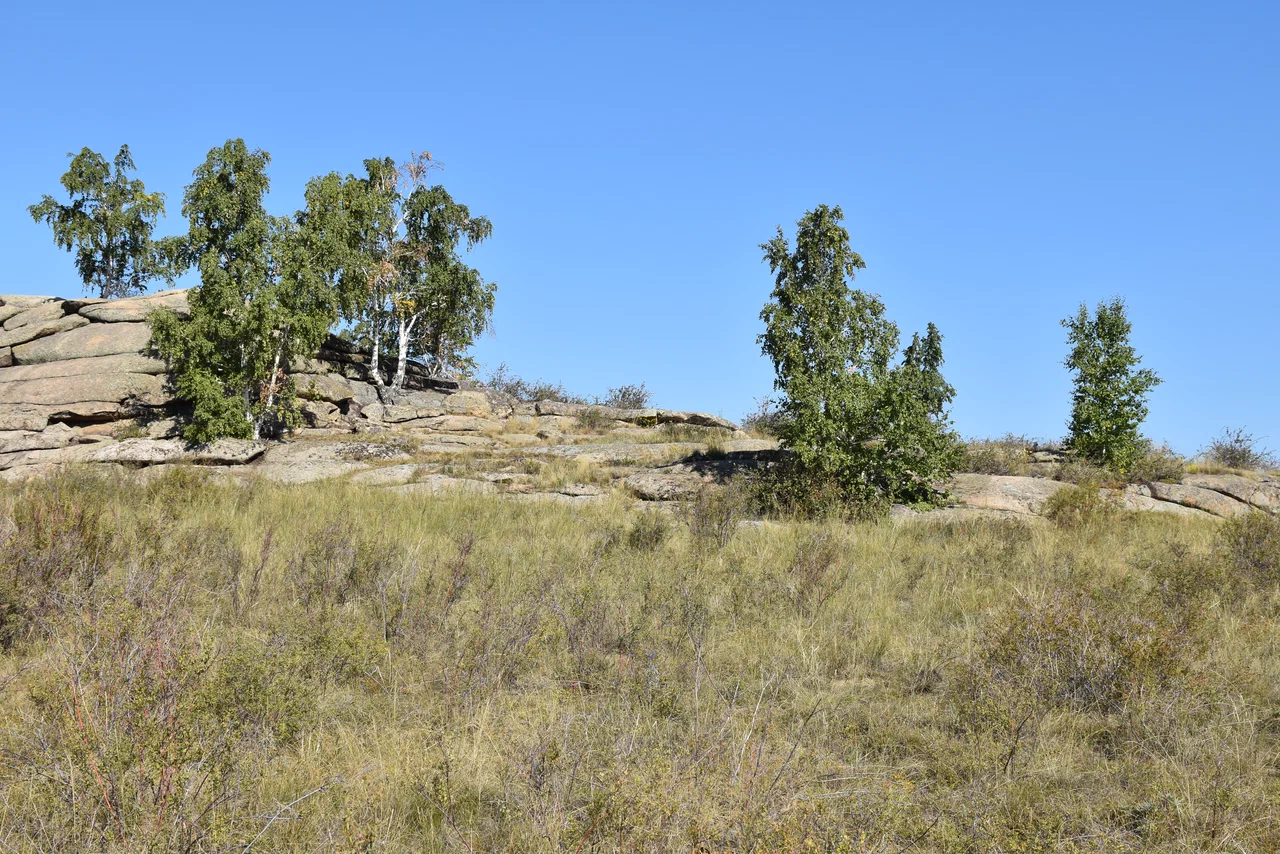
The Shonkal granite massif is a ridge of granite outcrops on the left bank of the Karabutak River, 2.5–3 km northwest of the village of Karabutak in the Adamovsky district of Orenburg Oblast. The rocks are a regional natural monument covering 41.6 hectares.
The massif consists of five separate rocky hills stretched into a broken ridge about 3 km long. Each hill is crowned by a rock bastion 30–50 meters high, built of enormous mattress-shaped granite blocks — a characteristic weathering pattern in which the rock splits into flat slabs stacked on top of one another. On each bastion two to five distinct towers, 4–9 meters high, can be made out; in shape these are typical pyramidal outcrops. The ridge lies along the western endocontact of the Karabutak pluton, a large granite body that is part of the Adamovsky intrusive complex. The rocks are made of light-gray biotite granite that formed in the late Paleozoic; aplite veins and zones of aplitization are clearly visible in the rock. The slopes adjoining the hills, and part of the watershed plateau, are also covered with large granite slabs.
Single and clustered birches grow in the crevices of the rocks, along with caragana (Siberian peashrub), black-fruited cotoneaster and dog rose. Moss and lichen are abundant on the shaded sides of the bastions — hollows and cracks in the granite collect rainwater, which helps the trees and shrubs survive the hot steppe summer. The herbaceous cover is made up of rock-dwelling plants: Mugodzhar thyme, needle-leaved carnation, spiny orostachys and hybrid stonecrop. The tops of the bastions offer a view over the surrounding Adamovsky steppe.
The Shonkal rocks lie 2.5–3 km northwest of the village of Karabutak in the Adamovsky district. A few kilometers from the massif is a memorial park at the site where cosmonaut Vladimir Komarov died. The massif is sometimes called the Karabutak granite massif, after the nearest village.
Shonkal is a regionally protected natural area, and visiting it is governed by its status as a natural monument. According to local residents, ribbons tied by visitors can be seen on the birches growing among the rocks.
No votes yet


No reviews yet. The first one helps the next travellers.