

Patomskiy Crater
1.5k km81
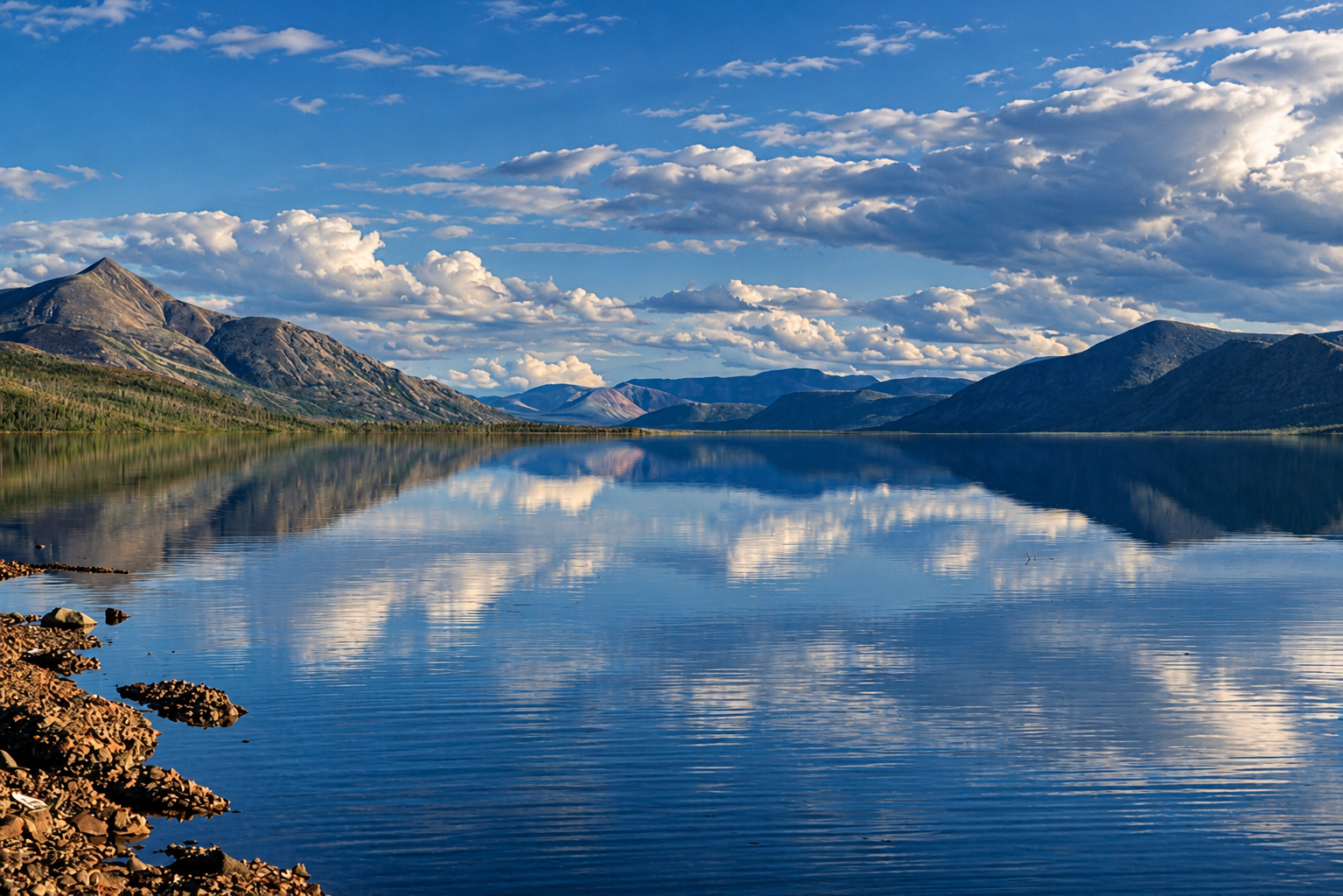
Lake Labynkyr lies in the Oymyakon district of Yakutia, in the upper Indigirka basin, on the Sordonokh plateau — in the coldest inhabited region of the Northern Hemisphere. The lake stretches 14 km, reaches a depth of 75–80 meters at its deepest point because of a crack in the bottom, and never fully freezes in winter: even in the harshest frosts the water near the bottom stays around +2 °C. This unusual lake has become one of Russia's best-known anomalous zones — local people say it is home to the "Labynkyr devil."
Stories about a monster in the lake circulated among the Yakuts and Evenks long before the rest of the country heard of it. The first official record of a sighting belongs to geologist Viktor Tverdokhlebov: on July 30, 1953, he and his colleague Boris Bashkatov saw a large moving object in the water and wrote in his diary that it was "something alive, probably some kind of animal." In the 1960s there were stories of a long-necked creature coming out of the lake onto the shore and making an eerie sound, and in 1964 it was seen by biologist Nikolai Gladkikh from an expedition team of the Yakutsk branch of the USSR Academy of Sciences.
According to one legend, an Evenk family stopped on the shore and their small son disappeared into the water: a creature with a huge maw emerged from the depths and dragged the boy under, and the grandfather caught it in a trap made of a leather sack with a smoldering splinter — the boy's body was found inside the creature's carcass. Witnesses describe the "devil" as dark gray, with a long neck and an enormous mouth; according to the stories, the distance between its eyes equals the width of a raft of ten logs. According to the Yakuts, the same creature periodically appears in the neighboring Lake Vorota, 20 km from Labynkyr — the two lakes are believed to be connected by an underground tunnel.
Cryptozoologists have offered various explanations: a giant pike, said to grow here up to five meters long, a relict reptile, or a prehistoric creature such as a plesiosaur. Some researchers believe the "devil" is mistaken for an optical illusion — one of the lake's three islands reportedly seems to disappear under water from time to time, even though the water level does not change. Geologist Sergei Karpukhin, who spent 35 days alone at the lake, doubts that a stable population of a large predator could survive here, and cryptozoologist Yuri Gerasimov of the Institute of Freshwater Biology of the Russian Academy of Sciences does not believe in the giant pike version. Diver Dmitry Shiller, who dived to the bottom of the lake, said that during his dives he only came across large char, not a monster.
The lake has been surveyed more than once specifically to search for the creature. In 1962–1964 ichthyologists concluded that the observed "monster" was probably a refraction of light in the water. In 1999 the Kosmopoisk group ran a winter expedition: sonar detected an object about 18 meters long in the water column, and at a depth of about 40 meters it found underground passages and cavities with no fish nearby. In 2005 the TV program "Iskateli" used sonar to find an anomalous crack on the bottom, and a deep-water probe to find remains of jaws and vertebrae; specialists from the Institute of Oceanology could not match the sound recorded underwater to anything known to science. On February 1, 2013, divers Dmitry Shiller and Alexander Gubin made a record under-ice dive here to a depth of 59.6 meters in frost down to −44 °C. In 2019 biologists compiled a species list for the lake — 123 taxa, including three new to science.
The lake is far from any road: the nearest settlement, Tomtor, is 105–123 km away, reachable from Yakutsk along the R-504 "Kolyma" highway in about 20 hours. From Tomtor to Labynkyr in summer there is only a cross-country track — about 123 km with two overnight camps, taking 7–8 hours by all-terrain vehicle. In winter people use heated all-terrain vehicles or trucks along an ice road: nearby is Oymyakon, the coldest inhabited place in the Northern Hemisphere, and nobody walks there. The nearest airport is in the settlement of Ust-Nera, 223 km from the lake.
On the lake itself there is a guesthouse only on the northern shore, and there are no permanent residents nearby. The water is cold even in summer, never above +9 °C, so swimming in Labynkyr is not common, but fishing is good — pike, burbot, grayling, char and Dolly Varden are caught here. In summer, insect repellent is essential: the surrounding forests still show dead trees left from fires in the 1990s.
No votes yet


No reviews yet. The first one helps the next travellers.