

Kholat Syakhl (Dead Mountain)
0.6 km1.9k1


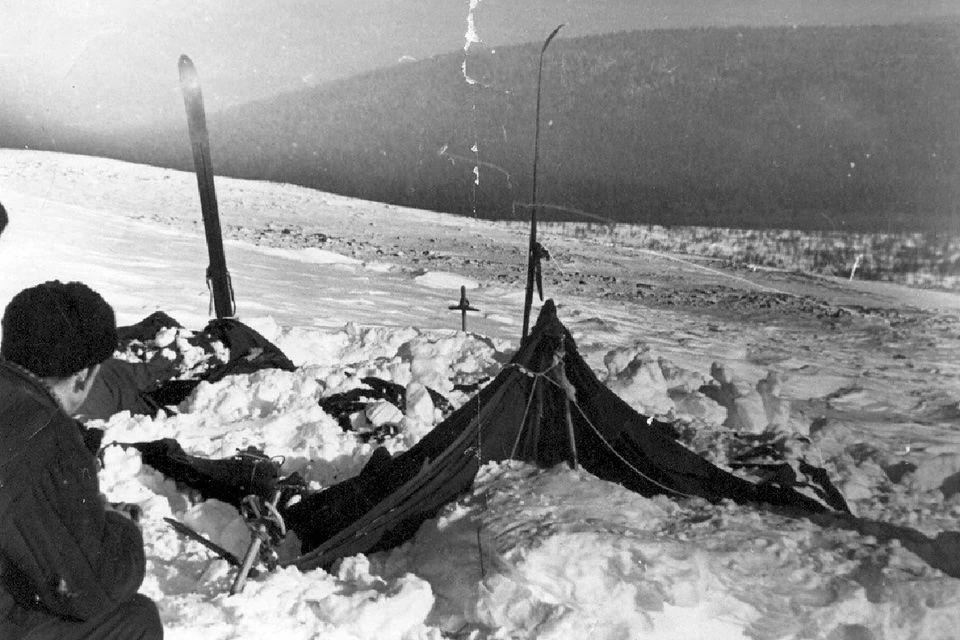
The Dyatlov Pass tent site is a spot on the northeastern slope of Kholat Syakhl (1,096.7 m; called "Height 1079" in the 1959 investigation documents, after an old topographic marking) in the Northern Urals, where on the night of 1–2 February 1959 nine hikers pitched the tent that became their last camp. The tent was found by a search party on 26 February 1959 — 26 days after the tragedy. According to the investigation, the campsite was located about 300 metres below the summit, at an altitude of around 900 metres, on an open, treeless slope.
The group consisted of nine people: Igor Dyatlov (the leader), Zinaida Kolmogorova, Lyudmila Dubinina, Yuri Doroshenko, Yuri Krivonishchenko, Rustem Slobodin, Nicolas Thibeaux-Brignolle, Alexander Kolevatov and Semyon Zolotaryov. A tenth member of the hike, Yuri Yudin, turned back on 28 January because of illness and survived.
The tent's exact coordinates were never recorded: in the criminal case file its position is marked on the map only approximately, and during the 2019–2020 re-investigation, investigators plotted three possible campsite locations on the scheme — based on searchers' testimony, Rosreestr analysis, and photo-forensic examination of the group's film. So the coordinates given on maps and in guidebooks are a reconstruction, not an exact fix from 1959.
The Dyatlov group's tent was made of two standard two-person tents sewn together, forming a shelter about 4.3 × 1.8 metres. The hikers set it up on a levelled platform dug into the snow on the slope. The tent's floor rested on skis laid crosswise under the groundsheet. It was secured with ski poles and guy lines tied to skis driven into the snow. The entrance faced south, toward the valley of the Auspiya River.
Pitching the tent on an open slope rather than in the forest (where it would have been warmer and more sheltered from the wind) remains one of the disputed questions. One version holds that the group wanted to shorten the route to Otorten; another, that they did not have time to descend before dark.
On 25–26 February 1959 the search party found the tent, partly covered in snow. One side had been torn, and the other cut open from the inside with a knife in several places. Inside lay the hikers' belongings: backpacks, padded jackets, felt boots, food, a flask of alcohol, cameras, diaries, documents and money. The wood-burning stove had been disassembled and stacked by the entrance — there had been no time to light it.
No one, living or dead, was in the tent. Tracks of bare and half-bare feet led down the slope from the tent toward the forest edge, about 1.5 km away. The bodies were found over the following months: two by a dying campfire under a cedar tree, three on the slope between the tent and the cedar, and four in a streambed under four metres of snow (these were found only in May).
The cuts in the tent's fabric are one of the key facts of the investigation. Forensic examination established that the fabric had been cut from the inside, with three strokes of a knife. This means the hikers got out of the tent in an emergency, not through the entrance. What made nine experienced hikers leave their shelter barefoot and without outer clothing in minus 30°C frost is the central question of the tragedy, and there is no definitive answer.
Among the most discussed: a slab avalanche that crushed the edge of the tent; hurricane-force wind or infrasound causing panic; the fall of a rocket stage (tests at Baikonur); an attack (by Mansi people, or escaped prisoners). No theory explains all the circumstances of the case.
The official version today is that of the Prosecutor General's Office of Russia: an investigation reopened in February 2019 officially concluded in July 2020 that the cause was a slab avalanche in visibility of about 16 metres — according to the finding, the hikers could not find the snow-covered tent in the darkness and blizzard and died of hypothermia a few dozen metres from it in temperatures of minus 40–45°C. This is the prosecutor's conclusion, not a conclusively proven fact: some researchers and relatives of the victims disagree with it.
The tent site is located on the slope of Kholat Syakhl, 16 km on foot from the Auspiya River. The nearest town is Ivdel (Sverdlovsk Oblast). From Ivdel it is about 100 km by logging roads to the start of the hiking route. The trek to Dyatlov Pass and the tent site takes 3–5 days. Mountain hiking experience and registration with the Ministry of Emergency Situations (EMERCOM) are required. In memory of the group, a memorial plaque with the names of the deceased was installed at the pass in 1963.
No votes yet


No reviews yet. The first one helps the next travellers.