

Manpupuner Rock Formations
311 km1.5k5
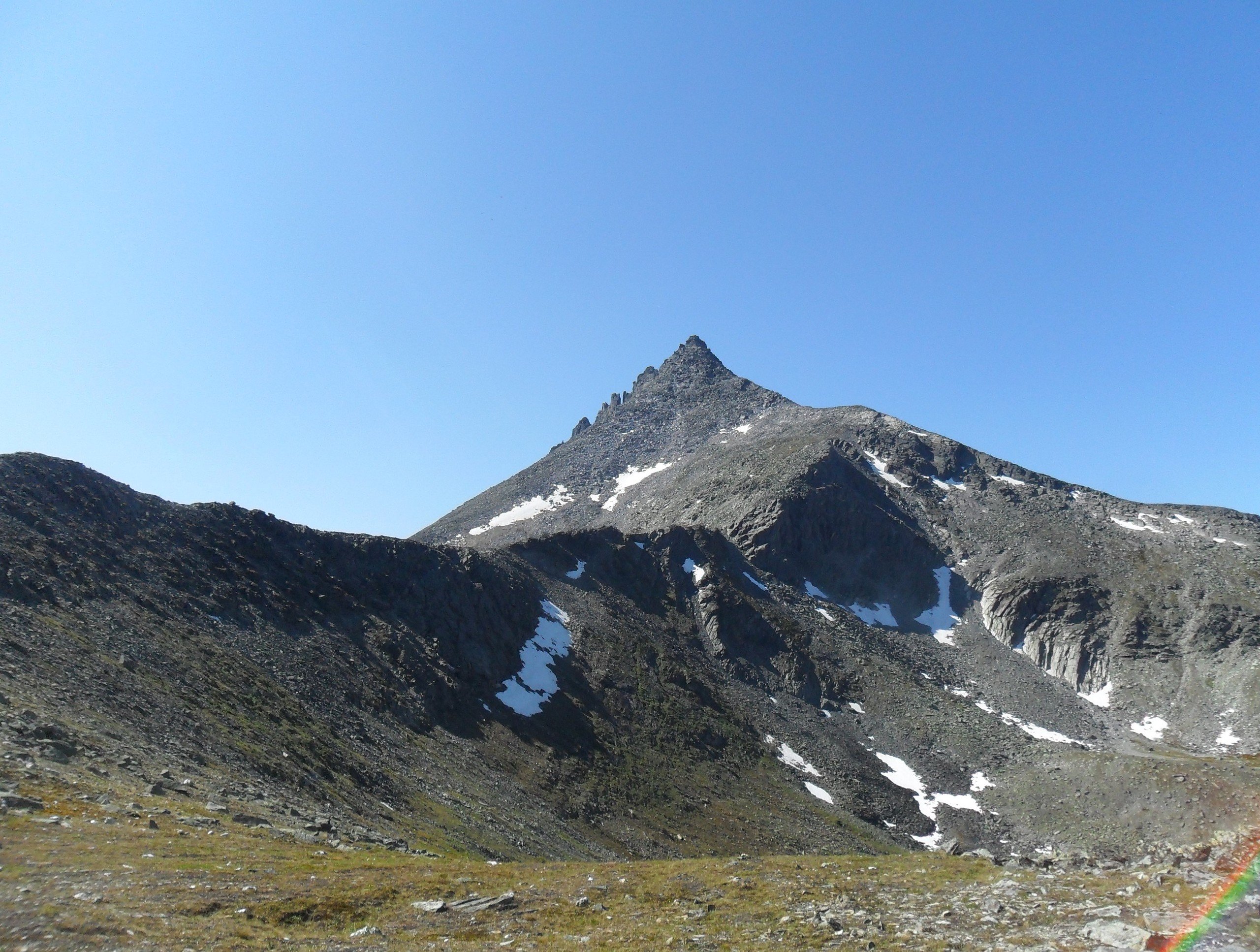
Manaraga is a 1,662-metre peak of the Subpolar Urals, in the Komi Republic, in the Pechora district. The mountain stands within Yugyd Va National Park, the largest national park in Russia, covering almost two million hectares. The Manaraga River, named after the mountain, flows past its southeastern foot.
The name comes from the Nenets words "mana" and "raha" and means "like a bear's paw." Seen from afar, the mountain's jagged, split ridge does resemble a clawed animal paw. In the Komi language the mountain has other names: Sizimyura, "seven-headed," or Unayuraiz, "many-headed." The summit is made up of seven separate peaks, which climbers call "gendarmes."
The Subpolar Urals explorer E. K. Hofmann was the first to describe Manaraga, in 1850, in his work "Pai-Khoi, or the Northern Urals," comparing the mountain's silhouette to a spiked, jagged spire. The mountain had appeared on maps of the Urals even earlier, in the mid-19th century, thanks to an expedition by the Hungarian ethnographer Antal Reguly. In 1927 and 1932 the geologist A. N. Aleshkov made a detailed survey of Manaraga. The first documented ascent of the summit was made in 1954 by tourists from Sverdlovsk.
Manaraga's highest point is the second "tooth" from the right; reaching it requires climbing gear and experience, and routes there are rated 2A–3A in difficulty. The right-hand "claw" is easier and can be climbed even by an unprepared hiker, though the approach over large boulders and scree fields still calls for caution. Traversing the ridge between the teeth is difficult and only suited to experienced groups.
The climate of the Subpolar Urals is harsh and changeable: winter temperatures drop below −25 °C, while from May to August the air warms up to +20 °C, and in autumn rain is regularly followed by night frosts. The favorable season for a trip is short, roughly from mid-July to the end of August.
Northern peoples considered the mountain mysterious and possessed of a special power: according to tradition, only shamans could climb it. A legend about the summit's divine origin was passed down from generation to generation, and local people avoided it for reasons beyond just the climate and remoteness. Part of Vladimir Sorokin's novel "Manaraga" is set on this mountain, and the composer and singer-songwriter Leonid Kurbatov dedicated a song, "Manaraga Waltz," to it.
The nearest major towns are Inta and Pechora, reachable by train from Moscow and other Russian cities; flights also go to Usinsk and Syktyvkar, with a train connection on to Inta. From Inta, the eastern entrance to Yugyd Va National Park is reached by all-terrain vehicle or off-road truck, a trip of several hours over roadless terrain.
The hiking route to the mountain starts from the Bolshoye Balbanty camp and follows the Balbanyu and Manaraga rivers; it runs about 107 km and takes 8 days, rated the first (easiest) category of difficulty. In winter the same route is covered on skis. Groups must register with the park administration no later than 10 working days before setting out, and campsites must be agreed in advance. In some seasons helicopter tours fly to the mountain from Ukhta and Nyagan, landing near the Manaraga shelter, though this is a rare and expensive option.
No votes yet


No reviews yet. The first one helps the next travellers.