

Tunguska Event
311.6 km311
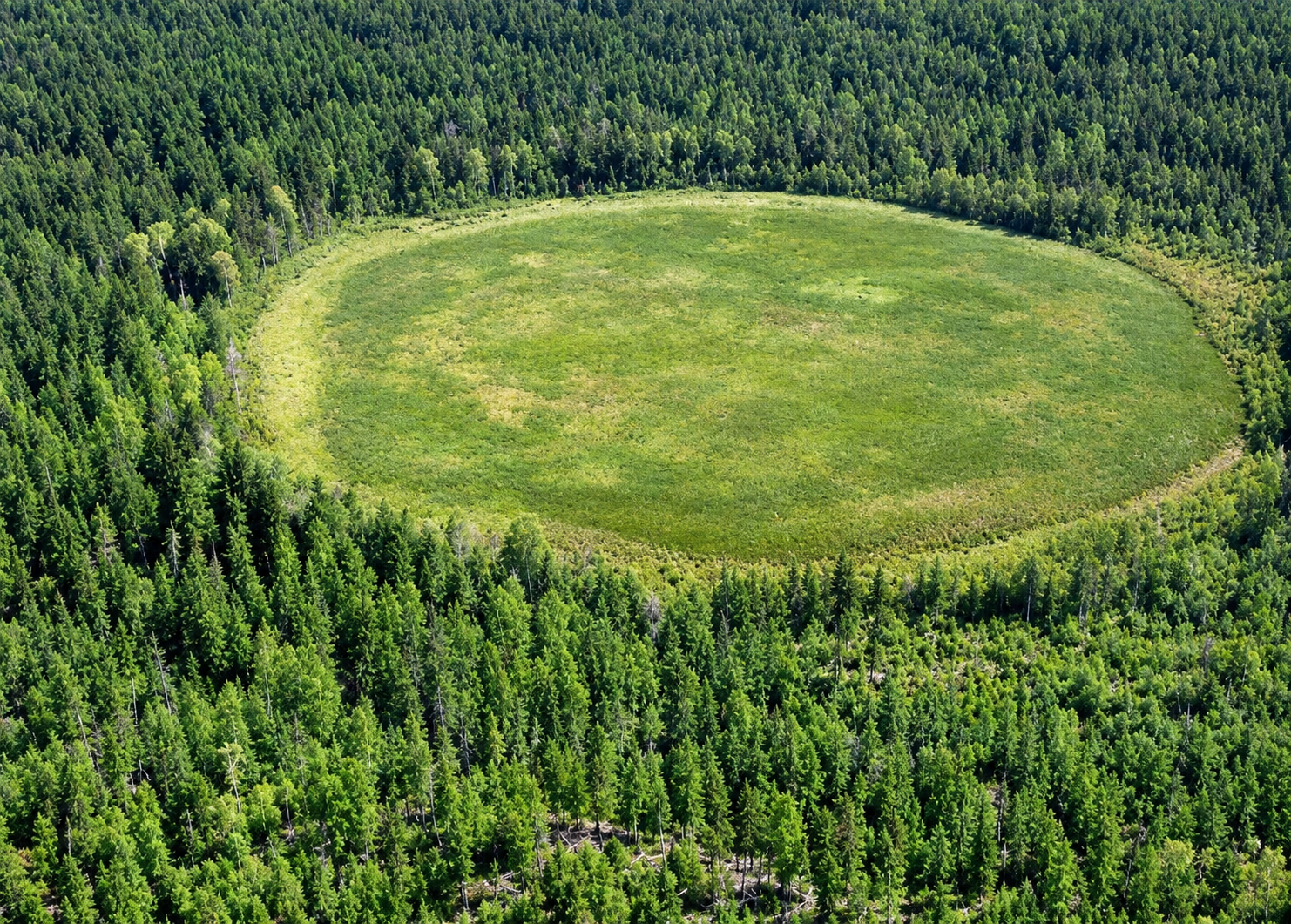
Devil's Cemetery (Chyortovo Kladbishche) is an anomalous clearing in the taiga of the Kezhemsky District of Krasnoyarsk Krai, in the basin of the Kova River, a tributary of the Angara, southeast of the town of Kodinsk. The name refers to a round or elongated patch of ground, from a few to several dozen metres across, nearly bare of vegetation, to which dozens of disappearances of people and livestock have been attributed.
Exiled agronomist Valentin Salyagin was the first to write about the clearing: in the Kezhma district newspaper of 24 April 1940 he recorded a hunter's account of the "devil's cemetery." After the Second World War, residents of the surrounding villages were resettled — partly because of unusually frequent deaths near the clearing — and there was no one left to show researchers the way. Interest revived after a 1983 article in the magazine Tekhnika — Molodyozhi; the first all-union search expedition set up camp in the abandoned village of Karamyshevo in 1984, and in 1991 the site was examined by researchers from the Far Eastern Technical University. Later, expeditions from the paranormal research group Kosmopoisk visited the site twice.
According to an old hunter's story, shepherds once found a dead bull with scorched hide lying on a black patch that looked burnt in a circle. Locals claim that animals that wandered onto the clearing disappeared, and that the ground was littered with bones. Trees at the clearing's edge are said to have blackened, charred-looking branches, and snow reportedly does not settle there in winter. One legend attributes the place to a banished shaman's curse; another holds that a crater formed there as early as 1916, giving off black smoke. Visitors report that watches start running 20 minutes slow, compasses and satellite navigation fail, and people get headaches and a slowed pulse.
The most common version links Devil's Cemetery to the 1908 Tunguska meteorite, although its presumed impact point lies roughly 400 km away, which makes experts sceptical of the theory. Scientific explanations include smouldering underground coal seams of the Tunguska coal basin releasing carbon monoxide (a hypothesis put forward by physicist Viktor Zhuravlyov in 1983) and low-frequency acoustic vibrations from crustal faults, which can cause malaise and panic. A geological version is also discussed — ore deposits and underground gas seepage in an area of ancient paleovolcanoes.
For decades even researchers struggled to find the exact spot: the landmark is the abandoned village of Karamyshevo, from which parties used to travel by all-terrain vehicle to the Michkan stream, while in recent years visitors have arrived by helicopter via the village of Vanavara, escorted by staff of the Tunguska Nature Reserve. Travelling into this remote taiga area without a guide is not recommended — it is easy to get lost, and camps are traditionally pitched no closer than a kilometre from the clearing itself.
No votes yet


No reviews yet. The first one helps the next travellers.