

Шишкинские писаницы
140.5 km3.9k3


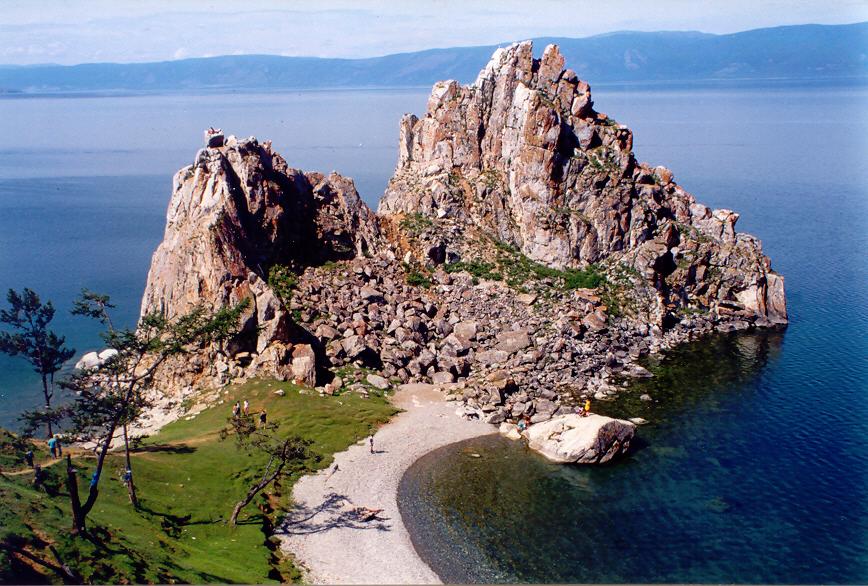
Shaman Rock, also known as Cape Burkhan, is a twin-peaked rock on Olkhon Island in the Olkhon district of Irkutsk Oblast, about 1 km from the village of Khuzhir and roughly 285 km from Irkutsk. It is one of the nine sacred shrines of Asia and the only one located in Russia: for centuries Buryat shamanists and Buddhists believed the rock to be the dwelling place of the spirit-master of Olkhon. The rock is made of white marble, dolomite and limestone with graphite inclusions; the peak closer to shore rises 30 m, the farther one 42 m. A cave up to 12 m long runs through the rock, with openings on its north-eastern and western sides.
According to legend, Burkhan — the fiercest and most revered deity of Lake Baikal — lived in the cave of Shaman Rock; local people prayed to him and shamans brought him offerings. Entering the cave was under strict taboo: only the chief shaman was allowed to perform rites here, and women were forbidden to come closer than two versts to the cape, lest they defile the sacred site.
A sacred grove once grew beside the rock, where deceased shamans were cremated and buried; today thirteen serge posts stand on that spot, one for each of the spirits said to descend to judge people. Pilgrims and tourists tie ribbons of different colours to the posts: green for health, red for love, yellow for wealth, blue for a cherished secret wish, and white as a token of gratitude.
Seen from the lake, a silhouette that legend describes as a dragon stands out clearly on the pale sheer wall of the rock, formed by rock of a contrasting shade. One story holds that at the start of every spring a passage to a parallel world briefly opens beside the rock.
Neolithic and Bronze Age burial sites and camps have been found near the cape, and more than 140 archaeological sites and over 20 ancient settlements with Iron Age rock inscriptions are known on Olkhon Island as a whole. After Tibetan Buddhism reached the Baikal region in the late 17th century, a Buddhist prayer room was set up in the cave of Shaman Rock; according to old-timers, as late as the early 20th century hundreds of lamas from Transbaikal monasteries still came here for services. In Soviet times white marble was quarried near the cape.
The site was designated the "Shaman Rock" nature monument on 19 May 1981; that status was abolished on 2 September 2020, and Cape Burkhan is now part of Pribaikalsky National Park.
By car from Irkutsk, drive to the village of Bayandai (about 125 km), then continue through Sakhyurta to the Olkhon Gates ferry crossing, which takes about 10 minutes. In winter, from 10 February to late March, an official ice road across the strait replaces the ferry. From the pier it is about 1 km to Khuzhir and on to the rock itself, an easy walk.
Shaman Rock is considered a place of power, and local residents advise visitors to behave quietly and respectfully here. Access to the rock is open to everyone today, and tours to Olkhon Island usually stop at Cape Burkhan as one of the most recognisable landmarks on Lake Baikal.
No votes yet


No reviews yet. The first one helps the next travellers.