

Monument to Vladimir Mulyavin (Ekaterinburg)
2.3 km2.2k1


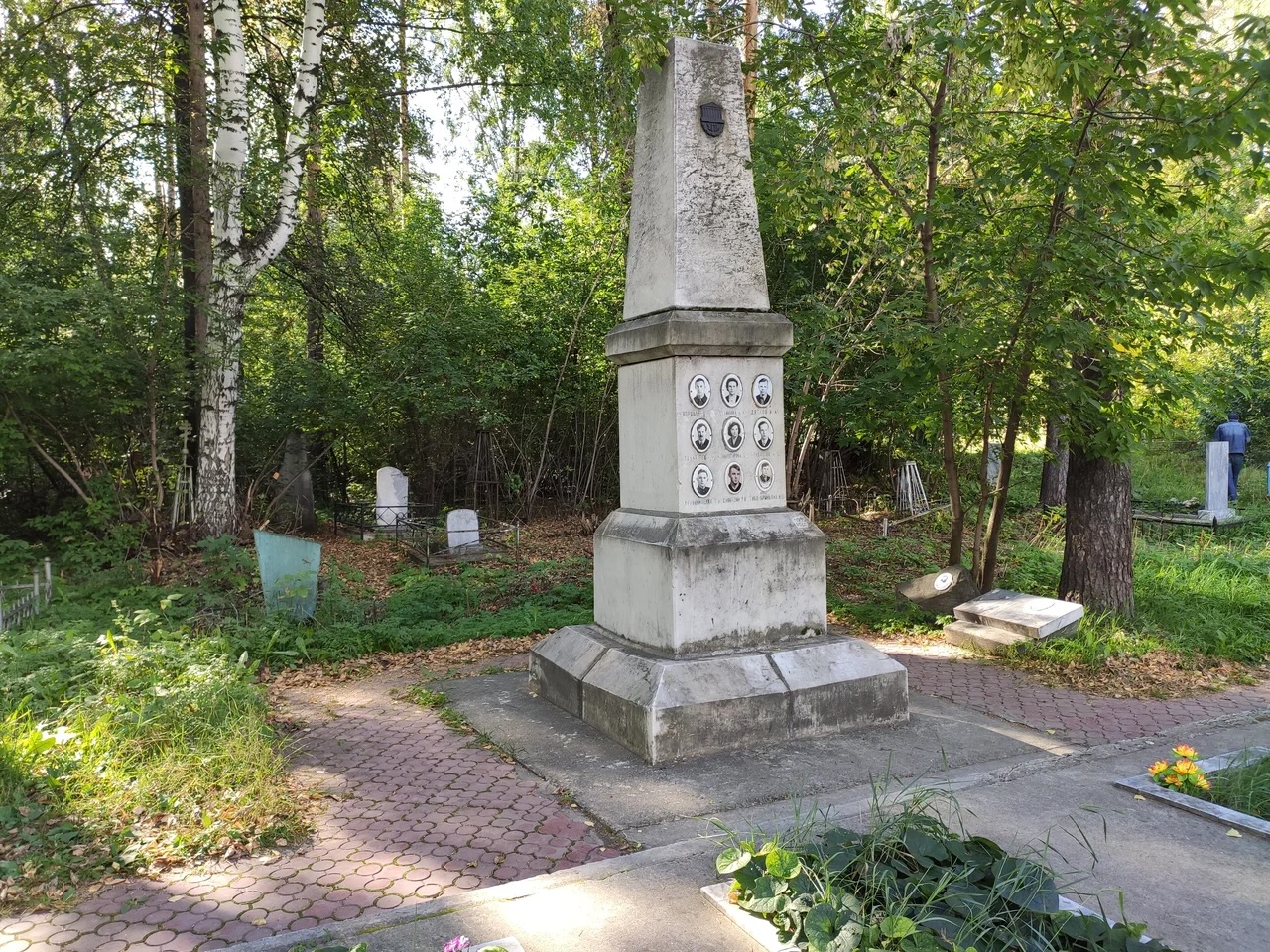
The graves of the Dyatlov group are spread across two cemeteries in Yekaterinburg. Seven of the nine hikers are buried at Mikhaylovskoye Cemetery (4 Blyukhera Street), where a memorial obelisk bears photographs of all nine who died. Two others — Yuri (Georgy) Krivonishchenko and Semyon (Alexander) Zolotaryov — were buried separately, at Ivanovskoye Cemetery (section 7). A tenth member of the hike, Yuri Yudin — the sole survivor, who had turned back early because of a leg injury — was laid to rest at Mikhaylovskoye in 2013.
The group died on the night of 2 February 1959 on a pass in the Northern Urals later named Dyatlov Pass after them. The Dyatlov Pass incident has spawned many theories over the decades, from an avalanche to man-made and even supernatural explanations. In 2019–2020 Russia's Prosecutor General's Office reopened the case and examined three natural-cause versions — a classic avalanche, a slab avalanche and a hurricane. Its official conclusion named an avalanche as the cause: in the dark, with visibility of around 16 metres, the hikers could not find their way back to the tent and died of hypothermia in temperatures of about −40 °C (Meduza, 11 July 2020).
The bodies were found over several months. The tent was discovered first, on 26 February 1959, followed by bodies near a cedar tree and on the slope. The last four were found only in May, under four metres of snow in a streambed.
The first funerals took place on 9 March 1959: Zinaida Kolmogorova and Yuri Doroshenko were buried at Mikhaylovskoye Cemetery. Igor Dyatlov and Rustem Slobodin were buried there the next day, on 10 March. Yuri Krivonishchenko was buried at Ivanovskoye Cemetery at his family's request — his parents were respected members of the community and chose a plot near other relatives.
Nikolai Thibeaux-Brignolles was buried at Mikhaylovskoye in March. On 11–12 May, after the last bodies were found, Lyudmila Dubinina and Alexander Kolevatov were buried there as well. Semyon Zolotaryov was laid to rest at Ivanovskoye, next to Krivonishchenko.
At the centre of the memorial at Mikhaylovskoye Cemetery lies the grave of Viktor Nikitin, a student of the Ural Polytechnic Institute (UPI) who died in March 1959. He had no connection to the Dyatlov group but was buried on a plot allotted to the institute before the last four bodies had even been found. His grave ended up at the centre of the memorial by chance, between parts of the group buried at different times. There is no photograph of him on the obelisk, but his name has become inseparable from the place.
On 22 April 2018, journalists from Komsomolskaya Pravda exhumed Zolotaryov's grave at Ivanovskoye Cemetery with the family's permission, aiming to confirm his DNA and identity (Zolotaryov went by Alexander during his life, though his documents listed him as Semyon). The analysis confirmed that Zolotaryov himself was indeed buried there, but the DNA did not fully match samples from relatives, which fuelled a new wave of theories.
Mikhaylovskoye Cemetery: 4 Blyukhera Street, Yekaterinburg (Vtuzgorodok district). Enter from Blyukhera Street, with a tower on the opposite side as a landmark; the memorial is about 300 metres along the central paved path from the main entrance. It is easy to spot: an obelisk with nine photographs and the inscription "Under this pass, on a snowstorm night of 2 February 1959, UPI tourists perished."
Ivanovskoye Cemetery: the graves of Krivonishchenko and Zolotaryov are in section 7, immediately to the right of the gate, along the fence.
No votes yet


No reviews yet. The first one helps the next travellers.