

Tunguska Event
832.5 km311
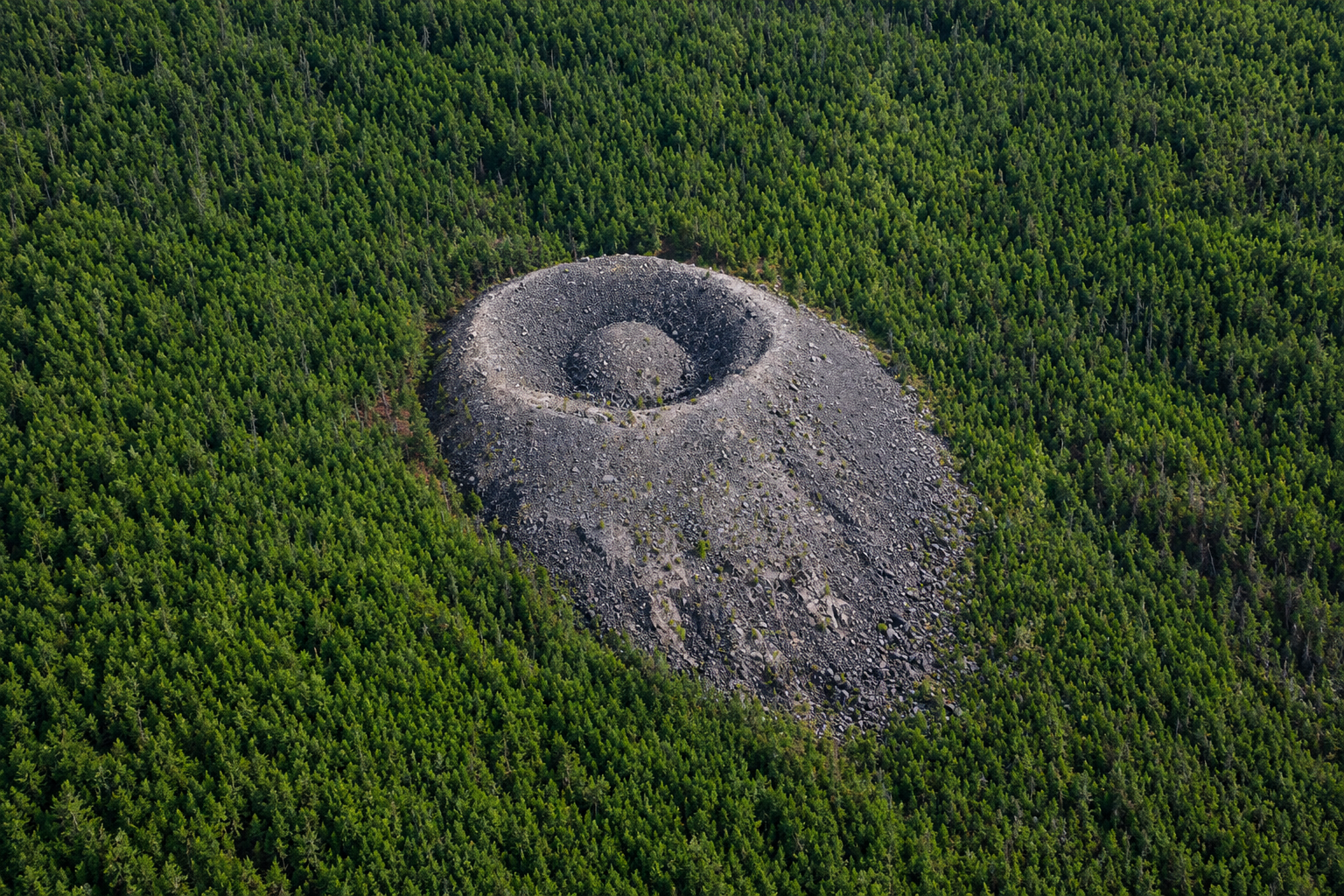
The Patomskiy crater is a cone of shattered limestone blocks on a mountain slope in the Patom Highlands, in the Bodaybo district of Irkutsk Oblast. The nearest town is Bodaybo, about 200 kilometres away over almost roadless terrain. The local Evenki and Yakut people call the site the "Nest of the Fire Eagle" — the cone really does resemble a giant bird's nest.
Geologist Vadim Kolpakov discovered the crater in the summer of 1949 while surveying the north of Irkutsk Oblast. He described it as a regular truncated cone with a flat top: 10 to 80 metres high, 130 to 150 metres across at the base, with a surrounding ditch 8 to 10 metres deep. The Evenki and Yakut people Kolpakov questioned told him that even reindeer avoid this mountain.
Systematic study of the crater began half a century later. In 1963 a semi-legal expedition of the Complex Amateur Expedition (KSE) reached it — 13 people from Tomsk and Novokuznetsk searching for traces of the Tunguska meteorite. In the soil they found many metal particles, including 101 tiny spheres of magnetised iron ore.
The first proper scientific expedition took place in 2005, with journalists from Komsomolskaya Pravda and geophysicist Yevgeny Vorobyov taking part. The group flew in from Mirny by helicopter, which could not land near the crater because of the steep slope, and wintered on the mountaintop five kilometres away. Expedition leader Yevgeny Vorobyov died of a heart attack while approaching the crater — specialists later called it a tragic coincidence. In 2006 and 2008 joint expeditions by Channel One and the Siberian Branch of the Russian Academy of Sciences ran ground-penetrating radar surveys and found a magnetic anomaly at a depth of 100 to 150 metres.
The Evenki called the land around the crater "cursed ground" that even animals avoid, and shamans forbade their people from climbing the cone or even mentioning it without strong need. According to legend, the ancestors saw a huge fiery bird descend from the sky and build itself a nest in the mountains — hence the name "Nest of the Fire Eagle" (Yakut: Өксөкүлээх уйата). There is also a story of a family that tried to settle near the crater and vanished without a trace, leaving their house, belongings and livestock behind. After the expedition leader's death in 2005, the place's ill repute only grew stronger.
For a long time the most popular explanation was a meteorite impact: the cone was thought to mark the fall of a celestial body, possibly linked to the Tunguska event. Scientists built a mathematical model of an impact by a cylindrical body 6 to 16 metres long, penetrating the rock to a depth of 100 to 300 metres — matching the radar data. However, comprehensive studies carried out between 2006 and 2010 did not confirm the meteorite version: the crater more likely formed through endogenous processes — deep gas and fluid flows reaching the surface.
This gave rise to the cryovolcano theory: an ice dome within the permafrost grew year after year until water trapped under pressure shattered the limestone and pushed it outward. There is also a gas-explosion hypothesis — an underground methane blast: researchers did record organic gases escaping from the crater. Another version suggests a young kimberlite pipe still forming within the rock, which in theory could mean diamonds lie beneath it. Tree-ring analysis of the larches growing on the crater's rim showed it to be about 500 years old, having formed roughly in the late 15th or early 16th century.
The easiest way to reach Bodaybo is by plane from Irkutsk, a flight of about two hours fifteen minutes. From there travellers hitch a ride with trucks heading to the gold mines as far as the village of Perevoz, then continue on foot up the Khomolkho river, along the right bank of the Yavaldin and Eksekyulyakh rivers, all the way to the crater. There are no roads for vehicles and no organised tours, so visitors only go with local guides.
No votes yet


No reviews yet. The first one helps the next travellers.