

Kuperlya Waterfall
8 km7k5
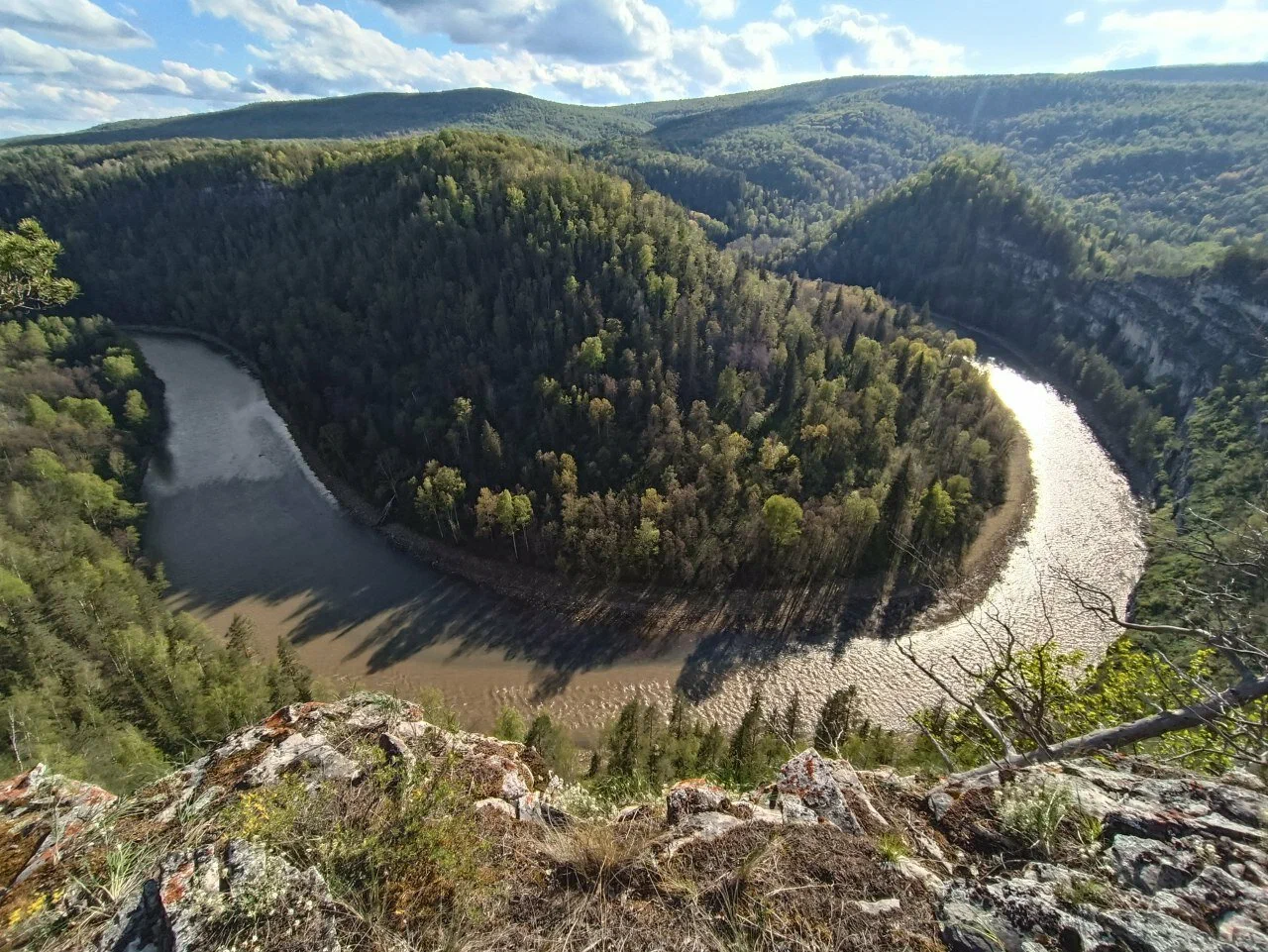
Pyatilistnik Canyon is a rocky canyon on the Nugush River in the Meleuzovsky district of Bashkortostan, within the Bashkiria National Park. The place is also known as Pyatikolenka, Romashka ("Chamomile") or Pyaternya ("The Five-fingered") for its distinctive shape: here the Nugush makes five large bends around a rocky massif, curving almost all the way around it — nearly 360 degrees. As a result, a narrow rocky isthmus turns the surrounding land into something like a small peninsula.
The main attraction is the shape of the canyon itself: from above and on a map, the river's five loops around the rock are clearly visible, almost returning to its own course. This is where the local names come from, and the place's remoteness is also why it is sometimes called a "mythical" corner of the park. The rocks contain several grottoes. A pine tree grows at the top of the cliff, its roots holding the rock together, and the slopes are covered with flowers in summer — the combination of bare rock and greenery makes the view from the trail memorable.
The canyon lies close to other natural landmarks of Bashkiria National Park — the Kuperlya waterfall and the Shulgan-Tash cave — so it is often combined with them in a single route, letting visitors see all three sites on one trip to the park.
Seen from above, the canyon's outline resembles a five-leaf plant — hence the name Pyatilistnik. Another comparison among visitors is a maple leaf, which the river's loops are said to resemble when viewed on a map or from the slope of a neighboring hill.
A mountain trail about 2 km long runs between the first and the fifth bend, noticeably shortening the walk compared to following the river around. Climbing up and down the worn path takes less than half an hour. The canyon can also be reached by car or motorcycle along forest roads on the "Nugush — Kuperlya" route. The canyon is especially popular in spring, during rafting trips down the Nugush River.
The canyon's territory is split into two parts: one belongs to the national park's strict protection zone and requires a permit, the other is an educational-tourism zone with free access. Because of its remoteness the place stayed little known for a long time, and even now it is sometimes called a "lost corner" of Bashkiria National Park.
No votes yet


No reviews yet. The first one helps the next travellers.