

Patomskiy Crater
2.1k km81
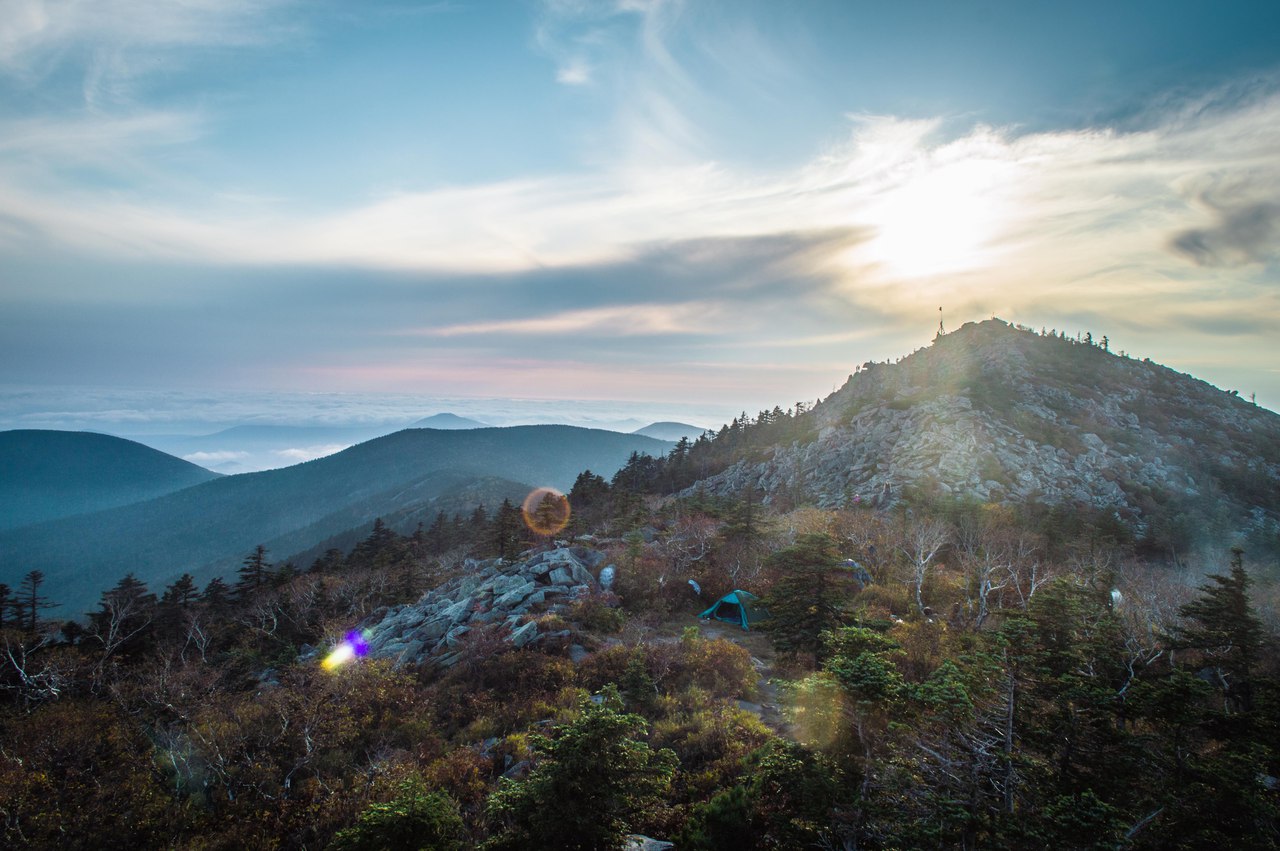
Mount Pidan, officially named Livadiyskaya, is one of the best-known peaks of Primorsky Krai, standing 1,332 metres high. It belongs to the Livadiyskiy ridge of the Sikhote-Alin mountain system and sits on the border of the Shkotovsky and Partizansky municipal districts, 150 kilometres east of Vladivostok. The village of Lukyanovka lies at its foot, with Anisimovka not far away.
The name Pidan is thought to come from Chinese words "pi" (big) and "dan" (rocks), meaning "big rocks"; another version holds that in the Jurchen language it meant "stones poured out by God". The mountain is first mentioned in connection with the Bohai state, for whose people it was, according to tradition, the main shrine. The summit is a granodiorite intrusion about 98 million years old and is almost entirely covered with courum, a field of stone scree. The mountain received its official name, Livadiyskaya, in 1972, when it was renamed after the ridge it belongs to; the older name Pidan stayed in everyday use and is still the one most visitors use.
Many legends surround the mountain. One says that God created Pidan by pouring out stone blocks at the request of two Bohai warriors who wanted rocks to train with. Another tells of a giant crystal on the summit that granted wishes and connected Bohai priests with the spirits; the crystal is said to have vanished seven hundred years ago and, by one version, turned into an underground sacred lake. There is also a story of a high priest who sacrificed himself to stop a war between warriors; after his wife could not survive the loss and died as well, her spirit is said to have become a protective ghost, the White Woman, who scares off predators and travellers. A separate group of stories concerns a winged, human-faced creature said to scream at night: in the early twentieth century newspapers wrote about a man with a flat face and webbed wings, and there are also rumours of aliens. Tradition holds that stone labyrinths and the body of a god are hidden inside the mountain, and that stone guardians known as "maori" — giant heads carved from rock, said to have once numbered 27 — used to glow and make sounds. Among hikers there are accounts of unexplained anxiety on the way up and relief on the way down, as well as wreckage of crashed helicopters reportedly found on the slopes, which is why some ufologists call Pidan an anomalous zone.
Geologists explain the mountain's puzzling stone structures — including a dolmen about 2.5 metres high, made of two massive blocks resting on four supporting stones, and a sacrificial stone along the trail — not as the work of an ancient civilisation but as relatively recent man-made masonry: geologist Viktor Steklenev and Professor Alexander Zinkov of the Far Eastern Federal University argue that such structures could have been built with a lever and a jack, and that there is no evidence ancient tribes built at such an altitude.
The mountain lies 150 kilometres from Vladivostok. A suburban train on the Vladivostok–Partizansk or Vladivostok–Tikhookeanskaya line reaches the "74 km" stop near the village of Lukyanovka in about two and a half hours. From there it is roughly 12 kilometres on foot to the foot of the mountain; a dirt track, passable for off-road vehicles and the tourist GAZ-66 truck, leads to a meadow, leaving another 4.5 kilometres to the summit. The climb takes about 4–5 hours, and the descent roughly the same; a one-day hike fits between 6:00 and 22:00. In clear weather the summit offers a view of the Sea of Japan and the coast from Nakhodka to Slavyanka.
Pidan is the most popular peak in Primorye: on a summer weekend it draws 1,100–1,200 hikers, sometimes up to 2,000, and the trail is worn down almost like a road. Climbing Pidan counts toward the "Primorsky Bars" badge, awarded for climbing ten mountains of Primorsky Krai with photos to prove it. The climate is temperate monsoon: winters are usually no colder than -10…-15°C, summers are rainy but warm, averaging about +20°C in July, so most hikers choose the drier, warmer autumn for the climb. One stage of the Primorsky Krai skyrunning mountaineering championship runs along the mountain's slopes.
No votes yet


No reviews yet. The first one helps the next travellers.