

Museum of Socialist Life (Kazan)
0.4 km1.3k3
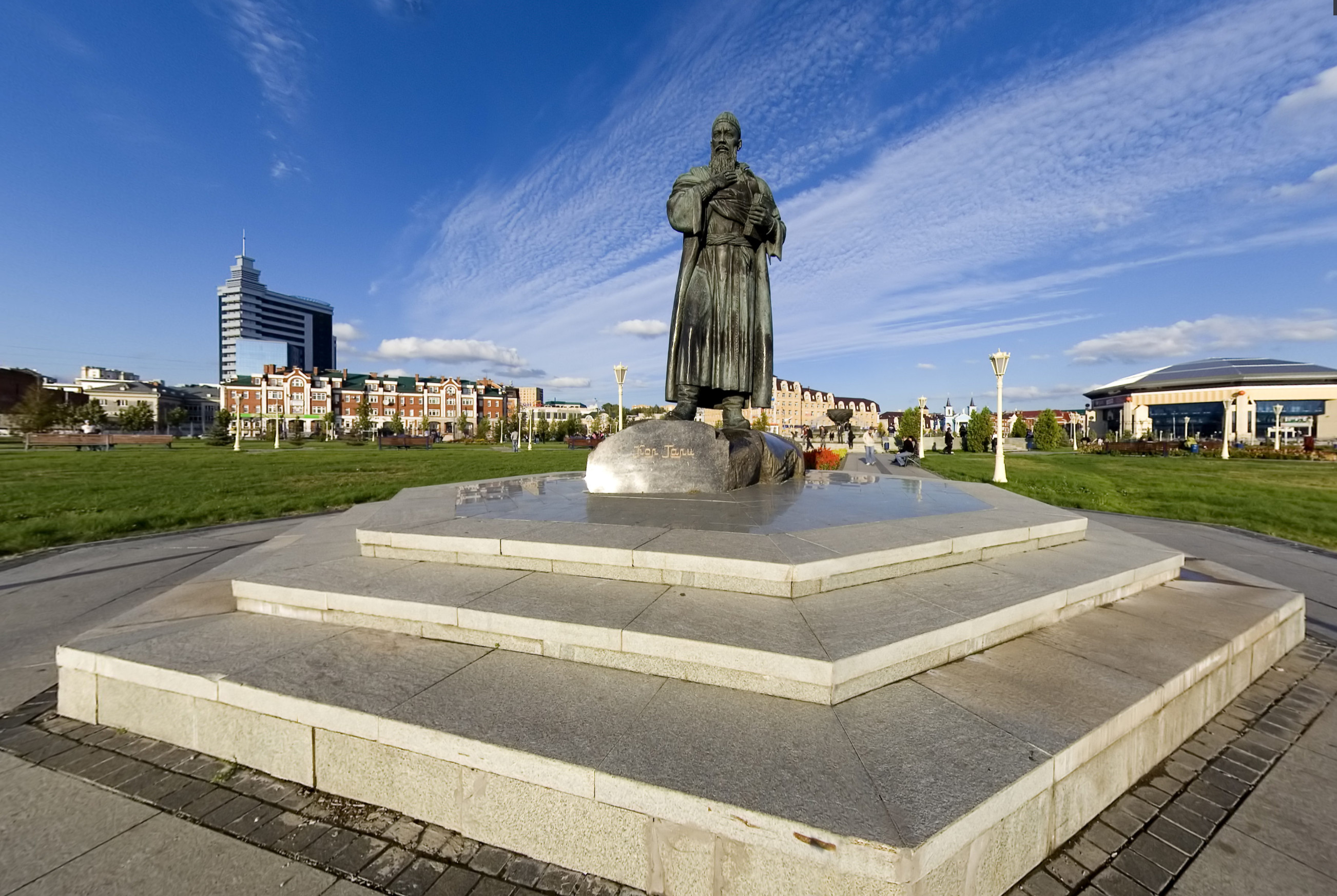
The Monument to Kul Gali (Kol Gali in Tatar) is a bronze statue of the medieval Bulgar poet in the centre of the Millennium Park in Kazan, on Marsel Salimzhanov Street by Lake Lower Kaban. It was unveiled on 26 August 2005, during the celebrations of Kazan's 1000th anniversary, and is one of the best-known pieces of public sculpture in Tatarstan.
The Millennium Park and the monument were laid out for the city's jubilee, and the statue was unveiled in front of guests who had come for the celebrations. It is the work of sculptors Andrei Balashov and Asiya Minnullina and architect Rozalia Nurgaleeva. The figure was cast in bronze by the Lit Art foundry in Zhukovsky.
In the middle of a stepped platform, on a low, irregular pedestal of Baltic Green stone shaped like a boulder, stands the four-metre figure of the poet. Kul Gali is shown as a tall, broad-shouldered old man with a full beard and a kind, attentive gaze, his right hand pressed to his chest and a book in his left. His name is carved on the pedestal in gold letters. Nearby, where the park's alleys meet, is a fountain shaped like a huge cauldron, surrounded by figures of zilants, the winged dragons of Kazan's coat of arms.
Kul Gali lived in Volga Bulgaria from the late 12th century to the first third of the 13th, a troubled time on the eve of the Mongol invasion. His poem Qissa-i Yusuf (The Tale of Yusuf) is regarded as the beginning of Bulgar-Tatar written poetry and the first narrative work of that literature. It retells the Biblical and Quranic story of Joseph and his brothers, and Kul Gali was the first Turkic-language author to take up the subject. A refrain, "imdi" ("now"), runs through the whole text.
Unlike the court poets, Kul Gali wrote about peace, friendship, honesty and justice, and about earthly rather than mystical love. The poem became part of the literary heritage of several Turkic peoples. Manuscript copies are kept in libraries and museums in St Petersburg, Berlin and Dresden; it was prepared for print by the poet and scholar Gabdrakhim Utyz Imyani and published in 1839 by the Kazan University press. It has been translated into Russian.
The nearest metro station is Ploshchad Tukaya, a few hundred metres' walk through the park. There are also surface transport stops on Marsel Salimzhanov Street next to the park. The inner part of the Millennium Park is pedestrian, and access to the park and the monument is free.
No votes yet


No reviews yet. The first one helps the next travellers.